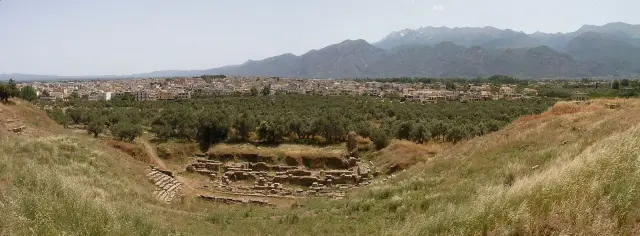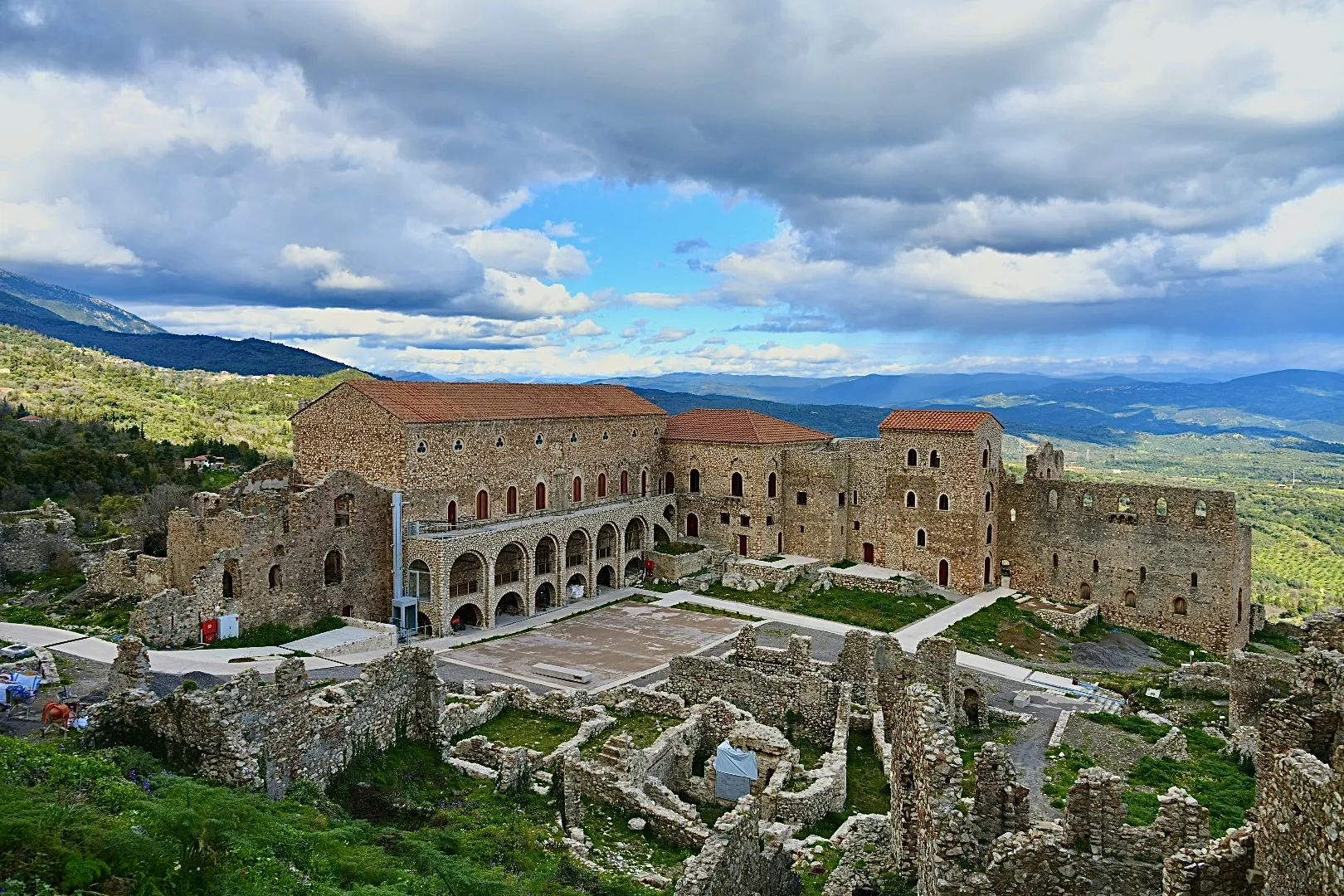
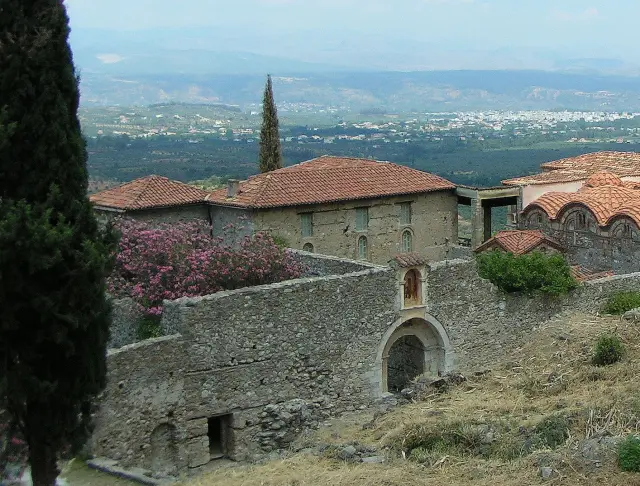
Mystras is the one sight near Sparta that nobody should miss. On a steep foothill of Taygetos, six kilometres west of the town, stand the remains of a whole Byzantine city: a castle on the summit, a palace, mansions, monasteries and some of the finest late Byzantine wall paintings anywhere. It has been a UNESCO World Heritage Site since 1989, and it is much quieter than the famous sites of Athens or Olympia.
This guide covers the practical side: tickets, opening hours, which entrance to use, a route through the site and what to bring. For the history and the individual monuments, see our pages on the castle-city, its churches and the Palace of the Despots.
Tickets and opening hours
Checked in November 2026. Prices and hours are set by the Greek state and can change, so check the official site before you go.
| Full ticket | €20 |
|---|---|
| Reduced ticket | €10 |
| Winter (1 November to 31 March) | 08:30 to 15:30 |
| Summer (April to October) | from 08:00, closing between 18:00 and 20:00 depending on the month |
| Last entry | about 20 minutes before closing |
| Closed | 1 January, 25 March, 1 May, Orthodox Easter Sunday, 25 and 26 December |
One ticket covers the whole archaeological site and the museum in the courtyard of the Metropolis. You can buy it at the gate or online from Hellenic Heritage, the state agency that runs Greece's archaeological sites. Reduced and free tickets exist for some visitors, such as young people and seniors from the EU, so bring ID and ask at the desk. On a few days a year entry is free for everyone.
Getting there
Mystras is a 10 to 15 minute drive from the centre of Sparta. Follow the signs west towards Mystras village; the road continues uphill to the site.
There are two entrances, each with its own car park:
- The lower gate is the main entrance, just above Mystras village, with the ticket office, toilets and the larger car park.
- The upper gate is near the castle at the top of the hill. Its car park is smaller and can fill up on busy summer days.
Without a car, a taxi from Sparta is the simplest option and costs around €10. A local bus runs to Mystras village a few times a day, but not often, so check the times at the bus station the day before.
Upper or lower gate?
The site is a steep hillside, and the castle stands a few hundred metres above the lower town. How you tackle it makes a real difference.
Top to bottom (easier). Take a taxi to the upper gate, climb the short way to the castle, then walk downhill through the upper town and the lower town to the lower gate. It is still a long walk on stone paths and steps, but it is all downhill.
Bottom to top (the classic). Start at the lower gate, see the lower town first, then climb to the palace and the castle. It is hard work in summer but gives you the whole city in order, from the cathedral at the bottom to the views at the top. With your own car, this is the natural choice, because you end up back at the car park where you started.
Either way, allow three to four hours, more if you want to go inside every church.
A route through the site
Starting from the lower gate, this route takes in the highlights in a sensible order.
- The Metropolis (Agios Dimitrios). The cathedral of Mystras, from the late 13th century, with frescoes and the small site museum in its courtyard. Tradition holds that Constantine XI Palaiologos, the last Byzantine emperor, was proclaimed here in 1449; a double-headed eagle carved in the floor marks the spot.
- The Brontochion monastery. Two churches, Agioi Theodoroi and the Hodegetria (also called Afentiko), whose wall paintings are among the finest of the 14th century.
- The Evangelistria. A small, elegant church on the way up.
- The Peribleptos. A little apart from the main path, at the edge of the lower town, and built partly into the rock. Its 14th-century frescoes are the highlight of Mystras for many visitors, so don't skip the detour.
- The Pantanassa. A monastery founded in 1428 and still home to a community of nuns, with a balcony looking straight down over the valley. Please dress modestly here (shoulders and knees covered) and keep your voice down.
- The mansions of Laskaris and Frangopoulos. The houses of noble Byzantine families, a reminder that Mystras was once a lived-in town.
- The Palace of the Despots. The great L-shaped palace of the Kantakouzenos and Palaiologos rulers, with its vast throne room, restored in recent years.
- Agia Sophia. The palace church of the upper town, on the path to the castle.
- The castle. The fortress at the summit, first built by the Frankish prince William II of Villehardouin in 1249. The view takes in the whole Evrotas valley, modern Sparta and Parnon on the horizon.
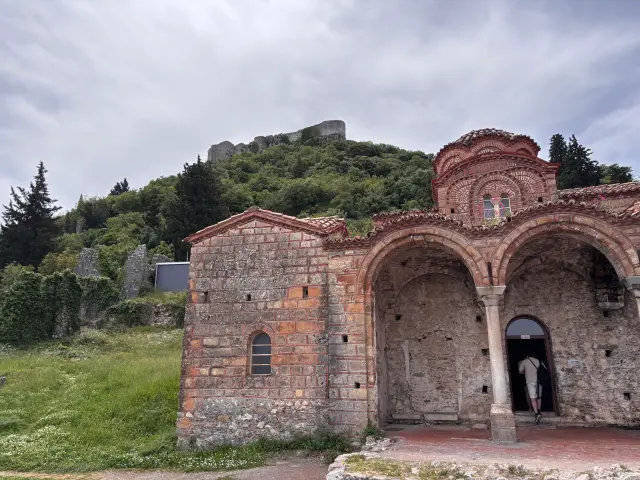 Churches of MystrasSeven major Byzantine churches with exceptional frescoes: Agios Demetrios (Metropolis), Agioi Theodoroi, Hodegetria, Hagia Sophia, Peribleptos and Pantanassa.
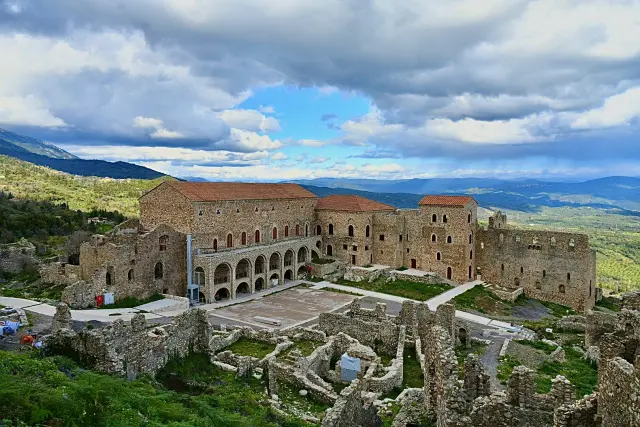 Palace of the DespotsImposing palace of the Kantakouzenos and Palaiologos despots: two wings and a 36 x 10 m Throne Hall with fireplaces and arched windows.
- Mystras CastleFrankish-era fortress with Byzantine and Ottoman phases, about 170 m long with two enclosures and a panoramic view of the Laconian valley.
 Archaeological Museum of MystrasFounded 1952: Byzantine sculpture, jewellery, pottery, coins and wall-painting fragments.
Mystras in five dates
- 1249: William II of Villehardouin, the Frankish ruler of the Morea, builds a castle on the hill.
- 1262: after his defeat and capture by the Byzantines, the castle is handed over to them, and a town grows on the slope below.
- 1349 to 1460: Mystras is the capital of the Despotate of the Morea, the last flowering of Byzantine art and learning. The philosopher Gemistos Plethon teaches here.
- 1460: the city surrenders to the Ottomans, seven years after the fall of Constantinople.
- 1834: the new town of Sparta is founded in the valley, and Mystras is slowly abandoned. Its ruins become a UNESCO World Heritage Site in 1989.
Tips for your visit
- Shoes: wear proper walking shoes with a good grip. The paths are uneven, polished stone and can be slippery.
- Water and sun: there is very little shade. Carry water, a hat and sun cream, and in summer start as soon as the site opens.
- Toilets: the only toilets are at the lower entrance.
- Mobility: the steep paths and steps make the site difficult for visitors with limited mobility. The upper gate gives the easiest access to the castle area.
- Take the map: you get a free leaflet with a map of the site with your ticket. Keep it handy, as signposting between the churches is limited.
After your visit
Have lunch in Mystras village or in Parori next door, where tavernas sit beside a spring under the plane trees, or drive up to Pikoulianika for a view back over the site. Camera lovers shouldn't miss the Camera Museum (Takis Aivalis) in Mystras, and walkers can follow the path above Parori to the rock-cut chapel of Panagia Lagadiotissa.
Combining Mystras with ancient Sparta in a single day? See Sparta in 1, 2 or 3 days. Coming from Athens? Read how to get from Athens to Sparta.